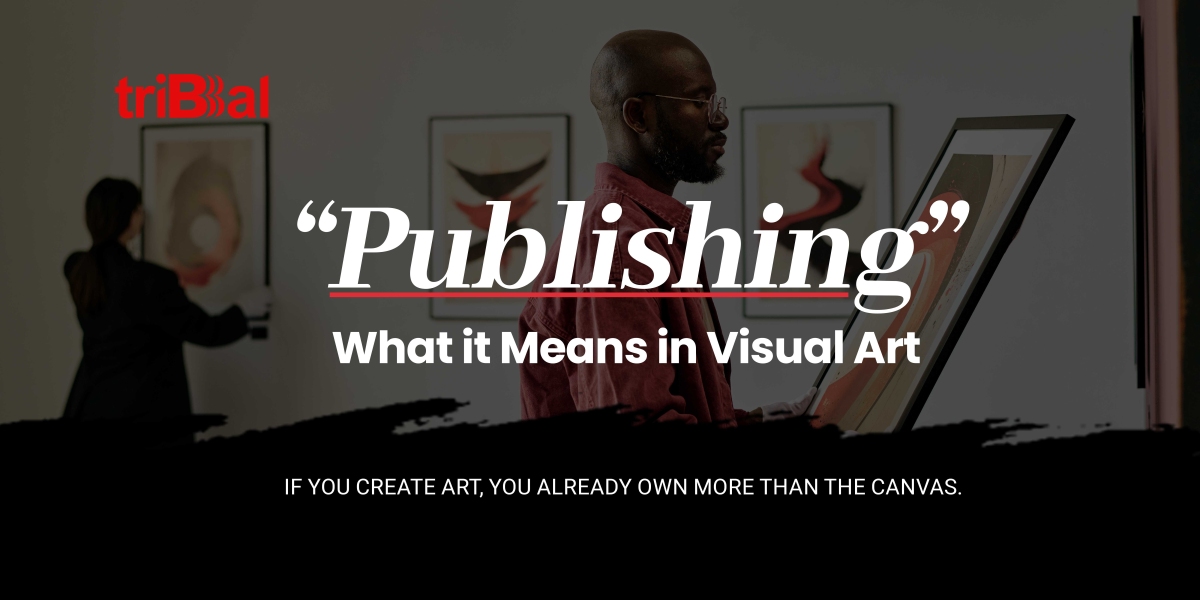
The term "publishing" is most commonly associated with the literary world — books, magazines, and newspapers. However, for the visual artist, understanding what "publishing" means is not merely an academic exercise; it is the core of their intellectual property strategy and the foundation for building a sustainable financial career. In the context of visual art, publishing is not just about distributing copies; it is about controlling the image, managing its reproduction, and leveraging the artist's ownership to create long-term value.
The Core Truth: Separating Object from Image
A fundamental concept that every visual artist must grasp is the distinction between the physical artwork and the rights to its image. This separation is the basis of all publishing in visual art.
"Selling a painting does not mean you are selling the rights to the image. The object can be sold. The rights stay with the artist — unless transferred in writing."
When an artist creates an original work — be it a painting, sculpture, or digital illustration — they automatically own the copyright, which is a form of protection provided by law to the creators of "original works of authorship". The act of selling the physical object (the canvas, the bronze, the file) transfers ownership of that material object, but it does not automatically convey the copyright or any of the exclusive rights that fall under the umbrella of publishing.
What "Publishing" Controls: The Exclusive Rights
In the most expansive sense, publishing in visual art is the mechanism by which the artist's ownership is used, shared, and carried forward. It is the control over the "business of the image". Legally, the copyright owner holds a bundle of exclusive rights, which collectively define the scope of publishing. These rights include:
- Reproduction: The right to make copies of the work.
- Distribution: The right to sell, rent, lease, or lend copies of the work to the public.
- Adaptation: The right to create derivative works based on the original (e.g., turning a painting into a design for a product).
- Public Display: The right to display the work publicly.
The U.S. Copyright Office defines a work as "published" when the original work, or a copy of it, is distributed to the public by selling, renting, leasing, lending, or otherwise transferring ownership of that copy of the work [4]. Crucially, merely displaying a work publicly, such as in a studio or a non-commercial setting, does not constitute publication; however, displaying it in a commercial gallery with an offer for sale does.
The Commercial Applications of Publishing
The exclusive rights of publishing translate directly into diverse revenue streams for the visual artist, allowing them to get paid beyond the first sale of the original object. Each commercial use of the image requires permission, which is typically granted through a license that specifies the terms of use, duration, and compensation.
Publishing Application
- Prints Editions - Reproduction of the artwork as physical copies for sale. Example is selling limited-edition giclée prints of a painting.
- Books Magazines - Licensing the image for inclusion in printed publications. Example is when museum catalog or an art history textbook featuring the work.
- Websites Digital Archives - Licensing the image for digital use and online distribution. Example is the use of the image on a stock photo site or a digital art archive.
- Merch Product Design - Licensing the image for use on commercial products. Example is reproducing the artwork on t-shirts, phone cases, or home goods.
- Film, TV Advertising - Licensing the image for use in media and promotional materials. Example is a painting appearing as set dressing in a movie or a photograph used in a commercial campaign.

Publishing as a Tool for Creative Equity
The strategic control over publishing rights is increasingly recognized as a vital tool for creative equity and artist ownership, particularly within marginalized communities. For artists who have historically faced systemic exclusion from traditional art market structures, controlling their intellectual property offers a pathway to financial independence and the ability to build a self-sustaining financial ecosystem.
By retaining and actively managing their publishing rights, artists ensure that they:
- Control the Narrative: They dictate how their work is presented, reproduced, and interpreted in the public sphere.
- Build a Legacy: They secure a long-term revenue stream that extends beyond their lifetime, strengthening their estate and legacy.
- Maximize Financial Return: They leverage the same creative asset across multiple markets and media, maximizing the financial return on their original creation.
In this context, publishing is a powerful act of self-determination. It transforms the artist from a mere creator of objects into a strategic manager of intellectual property, capable of navigating the complex modern media landscape on their own terms.
Conclusion
"Publishing" in visual art is the legal and commercial framework that governs the life of an artwork's image after its creation. It is the artist's right to control reproduction, distribution, and adaptation, and it is the key to unlocking long-term financial value. By understanding and actively managing these rights, visual artists can protect their work, build a robust business, and ensure that their creative ownership is used, shared, and carried forward for generations to come.
References
triBBBal2020. (2026). Publishing: What it Means in Visual Art https://www.instagram.com/p/DTCaan4DaEY/?hl=enimg_index=1
Artists Rights Society. (n.d.). Artists Rights 101. Retrieved from https://arsny.com/artists-rights-101/
U.S. Copyright Office. (n.d.). What Visual and Graphic Artists Should Know about Copyright. Retrieved from https://www.copyright.gov/engage/visual-artists/
U.S. Copyright Office. (n.d.). What Visual and Graphic Artists Should Know about Copyright (Section: Registering Your Work). Retrieved from https://www.copyright.gov/engage/visual-artists/
Forbes. (2022). Meet The Literary Lobbyist Fighting For More Black Representation In Publishing. Retrieved from https://www.forbes.com/sites/pauleannareid/2022/02/02/meet-the-literary-lobbyist-fighting-for-more-black-representation-in-publishing/
SLJ. (2015). Black Authors and Self-Publishing. Retrieved from https://www.slj.com/story/black-authors-and-self-publishing