The Positioning Secret Every Artist Needs
\Talent may attract attention, but positioning determines whether people remember you.
\Many artists spend years refining their technical skills, experimenting with different mediums, and exploring multiple creative styles. While artistic growth is essential, there\'s one mistake that quietly undermines countless careers: trying to appeal to everyone.
\At first glance, versatility seems like a strength. After all, shouldn\'t showcasing a wide range of abilities increase opportunities? Ironically, the opposite is often true.
\In today\'s competitive creative economy, collectors, galleries, and buyers aren\'t simply searching for beautiful artwork. They\'re searching for artists with a recognizable voice, a clear identity, and a body of work that tells a consistent story.
\The artists who build sustainable careers aren\'t always the most technically gifted, they\'re often the easiest to understand. That\'s the power of positioning.
\\
The \"Everything for Everyone\" Trap
\One of the most common fears among artists is that choosing a niche means losing potential income. The thinking usually goes something like this: \"If I paint landscapes, portraits, abstracts, and figurative work, I\'ll attract more buyers.\"
\On paper, that sounds reasonable. In reality, it creates confusion.
\When your portfolio moves in five different directions without a clear connecting thread, your audience struggles to understand what makes your work unique. Instead of appearing versatile, your brand begins to feel inconsistent.
\Collectors rarely fall in love with randomness. They connect with consistency.
\\
Why a Blurry Brand Costs More Than You Think
\Imagine a collector visits your website or Instagram profile. Within seconds, they should be able to answer one simple question:
\\"What is this artist known for?\"
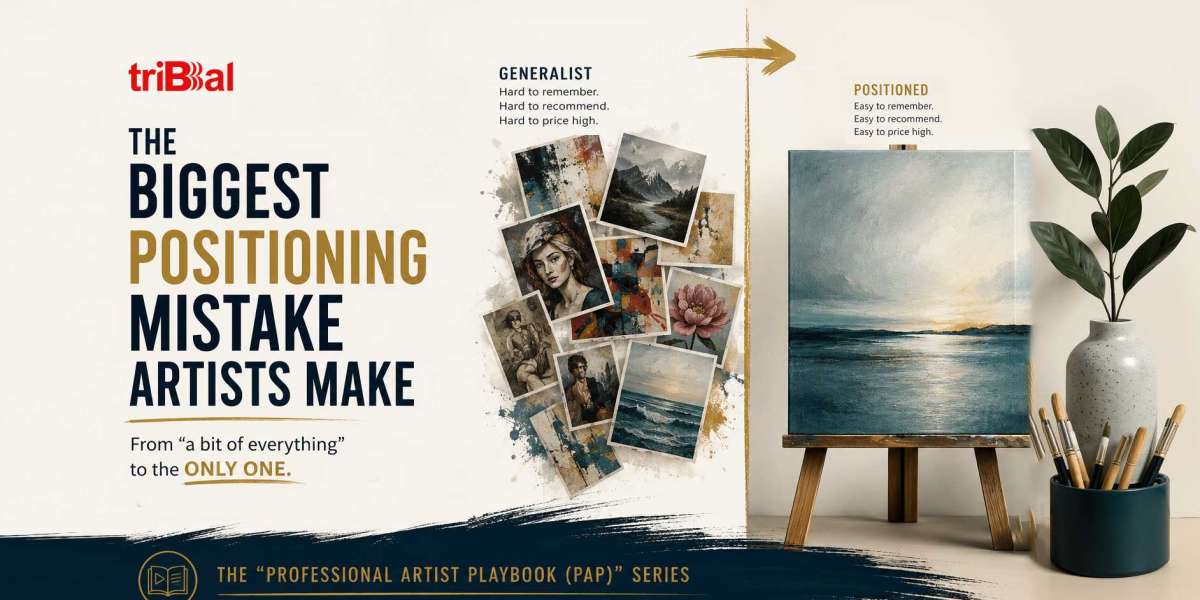
\If the answer isn\'t immediately obvious, you\'ve already created friction. A brand without clarity becomes:
\- \
- Difficult to remember \
- Difficult to recommend \
- Difficult to justify premium pricing \
This has little to do with artistic ability. It has everything to do with perception. People remember specialists because specialists become associated with something specific.
\Think about the artists whose work instantly comes to mind.
\You probably don\'t remember every piece they\'ve ever created, you remember the feeling, the subject matter, or the unmistakable style that defines them.
\That\'s positioning at work.
\As the saying goes: Clarity beats talent. Every. Single. Time.
\\
Collectors Don\'t Buy \"Art\"
\One of the biggest misconceptions in the creative industry is believing people buy artwork simply because it\'s visually appealing.
\They don\'t.
\Collectors invest in meaning. They buy a perspective. They buy an emotion. They buy a story. They buy something that reflects their identity or transforms the atmosphere of a particular space.
\A minimalist collector isn\'t searching for every style imaginable. They\'re searching for work that complements a specific lifestyle. A corporate buyer isn\'t looking for \"good art.\" They\'re looking for artwork that communicates professionalism, sophistication, or innovation.
\Every purchase solves an emotional or aesthetic problem.
\When your work consistently solves that problem for a clearly defined audience, your value increases dramatically.
\\
Discover Your \"Red Thread\"
\Every memorable artist has what can be described as a Red Thread—the invisible connection that ties their entire body of work together.
\It isn\'t necessarily one subject. It isn\'t one color palette. And it certainly isn\'t one medium. It\'s the deeper idea that makes your work unmistakably yours. Finding that thread starts with asking three important questions.
\1. What Is Your Core Theme?
\What idea keeps pulling you back?
\Perhaps it\'s:
\- \
- Nostalgia \
- Identity \
- Solitude \
- Chaos \
- Spirituality \
- Nature \
- Human resilience \
Your strongest work often revolves around the same emotional conversation, even if the subject matter changes.
\2. Who Is Your Work Really For?
\Not everyone will connect with your art. That\'s perfectly okay. Instead, think about the person who instantly feels understood by your work. Who are they? What lifestyle do they live? What emotions are they seeking? What spaces are they decorating?
\The more specific your audience becomes, the easier it becomes to create work that genuinely resonates.
\3. What Problem Does Your Art Solve?
\Art doesn\'t have to solve practical problems. It often solves emotional ones. Perhaps your work helps people:
\- \
- Slow down \
- Feel hopeful \
- Reconnect with memories \
- Celebrate culture \
- Find calm amid busy lives \
- Express personal identity \
Understanding the emotional value behind your work helps communicate its worth far beyond its materials.
\\
Run a Positioning Audit
\If you\'re unsure whether your brand has clear positioning, try this simple exercise.
\Ask yourself: If I could only show three artworks for the rest of my career, which three would I choose?
\Now look at them carefully. What connects them? Is it the mood? The story? The composition? The symbolism? The emotional response?
\That common thread is likely the foundation of your artistic identity.
\Instead of building your brand around every piece you\'ve ever created, build it around the work that best represents that central idea.
\Your strongest positioning already exists. You simply need to recognize it.
\\
Generic vs. Positioned
\Consider the difference between these two artist introductions:
\- \
- The Generic Artist - \"I create beautiful oil paintings inspired by whatever catches my attention.\" \
There\'s nothing technically wrong with this statement. But it doesn\'t create a memorable identity.
\Now compare it with this.
\- \
- The Positioned Artist - \"I create minimalist seascapes that evoke deep meditation for modern urban homes.\" \
Immediately, you understand:
\- \
- What they create \
- Who it\'s for \
- The emotional experience it delivers \
- Where it belongs \
That\'s the difference between being descriptive and being positioned.
\One competes on price. The other competes on value. And value commands premium pricing.
\\
Positioning Doesn\'t Limit Creativity—It Amplifies It
\Many artists resist positioning because they fear it will restrict their creative freedom. In reality, the opposite happens. A clear position creates trust. Trust creates recognition. Recognition creates opportunities. You can still experiment. You can still evolve. You can still grow.
\But when your audience understands the thread connecting your work, every new collection strengthens your reputation instead of confusing it.
\Positioning isn\'t about placing creative boundaries around your imagination. It\'s about giving people a compelling reason to remember your work.
\\
Final Thoughts
\In a world overflowing with incredible art, talent alone is rarely enough. What separates memorable artists from overlooked ones isn\'t simply technical ability, it\'s clarity. Your goal isn\'t to become everything to everyone. Your goal is to become unforgettable to the right people. Find your Red Thread. Build your brand around it. Communicate it consistently.
\Because the most successful artists aren\'t the ones trying to fit into every conversation, they\'re the ones leading a conversation that only they can have.
\Stop being a bit of everything. Start becoming the only one
\\
Explore more insights in triBBBal\'s Professional Artist Playbook (PAP) series for practical strategies on pricing, branding, marketing, and building a sustainable art career.
\