There is a hard truth many artists avoid: your art not selling does not automatically mean your art is not good. It may be meaningful. It may be visually powerful. It may be technically strong. It may even be better than work you see selling every day. But quality alone does not guarantee sales.
\In today’s creative economy, art rarely sells simply because it exists. People need to understand it. They need to see it consistently. They need to connect with the story behind it. Most importantly, they need to believe that owning your work means something.
\That is where many artists get stuck.
\They focus almost entirely on creation, then feel frustrated when the market does not respond. But selling art requires more than talent. It requires positioning, presentation, visibility, trust, and a clear understanding of who the work is for.
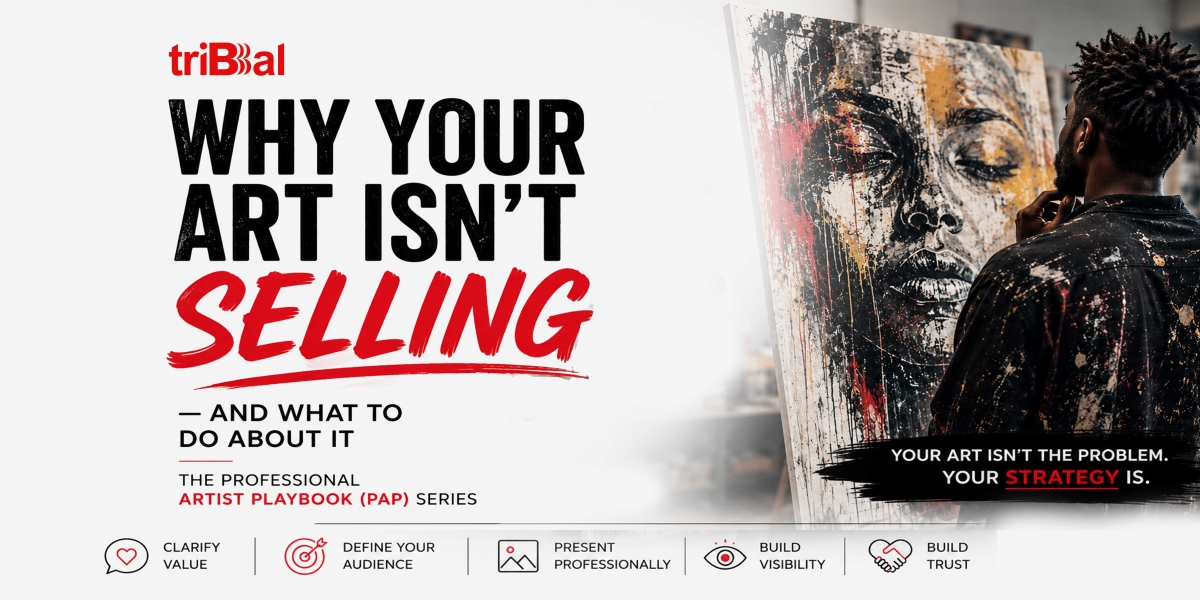
\Your art may not be the problem. Your strategy might be.
\This is the Professional Artist Playbook approach: Create. Position. Sell. Repeat.
\\
Great Art Still Needs a Clear Message
\People do not just buy art. They buy emotion. They buy identity. They buy meaning. They buy the feeling of seeing themselves, their values, their memories, or their aspirations reflected in a piece.
\A collector is rarely thinking, “I need another object for my wall.” More often, they are responding to something deeper: a mood, a story, a personal connection, a cultural reference, or a sense of belonging. That means your work needs to communicate why it matters.
\If someone sees your art and has no idea what it is about, what inspired it, or why they should care, they may scroll past—even if the work is strong. In a crowded digital landscape, unclear art is easy to ignore. This does not mean every piece needs a long explanation. It means every piece should have a point of connection.
\Ask yourself:
\What is this work really about?
What do I want people to feel when they see it?
What story, memory, tension, or transformation does it hold?
Why would someone want to live with this piece?
A strong artist does more than display the final work. They help people enter the world behind it. Instead of simply posting, “New painting available,” try giving people a reason to care. Share what sparked the piece. Explain the emotion behind the colors. Talk about the experience, community, or idea that shaped it.
\You are not just selling canvas, pigment, pixels, or prints. You are selling resonance.
\\
If Your Audience Is Everyone, Your Message Becomes Forgettable
\One of the biggest mistakes artists make is trying to appeal to everyone. At first, this feels logical. The more people you reach, the better your chances of selling, right?
\Not quite.
\When your work is positioned for everyone, your message often becomes too broad to move anyone. You end up sounding vague, inconsistent, or generic. The result is that the people most likely to love your work may never realize it is meant for them.
\A professional artist thinks clearly about their ideal collector.
\That does not mean changing your art to please the market. It means understanding who naturally connects with what you already create.
\Who is your ideal collector?
What do they love?
What do they value?
What kind of spaces do they live or work in?
What stories do they relate to?
What would make your work feel personal, powerful, or necessary to them?
For example, an artist creating bold, heritage-inspired work may be speaking to collectors who value culture, identity, and legacy. An artist creating minimalist abstract pieces may attract collectors who care about calm, design, and atmosphere. An artist creating provocative social commentary may resonate with people who want art that challenges, disrupts, and starts conversations.
\The clearer you are about your audience, the stronger your positioning becomes.
\You stop shouting into the crowd and start speaking directly to the people most likely to listen.
\\
Presentation Can Make or Break the Sale
\Great art can look average when it is presented poorly.
\This is especially true online, where collectors often meet your work through a screen before they ever see it in person. Low-quality photos, cluttered backgrounds, inconsistent branding, and messy social feeds can quietly damage the perceived value of your art.
\The work may be excellent, but the presentation may be telling a different story.
\Collectors pay attention to signals. They notice whether the images are clear. They notice whether the artist looks intentional. They notice whether the body of work feels cohesive. They notice whether the buying experience feels professional or confusing.
\Presentation builds confidence.
\A polished presentation does not require a luxury studio or expensive production team. It requires intention.
\Use clean backgrounds. Photograph your work in good light. Show scale when possible. Use professional mockups for prints or digital work. Keep your visual identity consistent across your website, portfolio, and social platforms.
\Your online presence should make it easy for someone to understand what you create, why it matters, and how they can buy it.
\Think of presentation as part of the artwork’s frame.
\It does not replace the work—but it shapes how people experience its value.
\\
Visibility Is Not Optional
\You cannot sell what people do not see.
\Many artists post inconsistently, disappear for weeks, then return frustrated that their audience is not engaged. But attention is built through repetition. People need to encounter your work multiple times before they remember you, trust you, and consider buying from you.
\Visibility creates opportunity.
\This does not mean you need to be online every hour of the day. It means you need a consistent rhythm that keeps your work in front of people. Show the finished pieces. Show the process. Share the story behind the work. Talk about what is available. Remind people how to collect from you. Let your audience see the evolution of your practice.
\The mistake is assuming that one post should create one sale.
\In reality, one post is part of a larger relationship. Someone may need to see your work ten, twenty, or fifty times before they are ready to buy. That does not mean your content is failing. It means you are building familiarity.
\Professional artists do not rely on random bursts of attention.
\They build visibility systems.
\That could mean a weekly studio update, a monthly collection drop, daily short-form content, an email list, behind-the-scenes reels, collector stories, or regular posts that educate people about your work.
\Consistency keeps you in the conversation.
\And in the art market, being remembered matters.
\\
No Trust, No Sale
\People do not buy from artists they do not trust.
\Trust is especially important when someone is buying original work, commissioning a piece, or investing in a higher-priced item. They want to know who is behind the art. They want to feel confident that the artist is serious, reliable, and professional.
\If your audience only sees finished artwork with no context, no personality, no proof, and no process, they may hesitate.
\Trust grows when people can see the human behind the work.
\Show your studio. Share your process. Talk about your journey. Let people see how pieces are created, packaged, shipped, installed, or collected. Share client feedback and testimonials. Highlight collectors who have purchased from you. Explain what makes your materials, methods, or message meaningful.
\This is not about oversharing. It is about building credibility.
\A collector wants to feel like they are buying from someone with intention.
\Behind-the-scenes content is powerful because it turns a finished piece into a living story. Testimonials are powerful because they reduce uncertainty. Your personal story is powerful because people connect with people before they connect with products.
\The more trust you build, the easier it becomes for someone to move from admiration to action.
\\
Stop Waiting for the Art to Sell Itself
\One of the most damaging myths in the creative world is that good art should sell itself.
\It sounds romantic, but it is not practical.
\Art needs context. Art needs visibility. Art needs language. Art needs a pathway from discovery to purchase. Art needs an artist who is willing to think beyond creation and step into professional positioning.
\That does not make the work less authentic. It makes the work more accessible.
\If your art is not selling, do not immediately assume the work is not good enough. Instead, look at the system around the work.
\Is the value clear?
Is the audience defined?
Is the presentation strong?
Is the visibility consistent?
Is trust being built?
Is there a simple way for people to buy?
These questions move you from frustration to strategy. And strategy is what turns creative potential into sustainable income.
\\
The Professional Artist Mindset
\The artists who win are not always the most talented. They are often the most intentional.
\They understand that creativity and strategy are not enemies. They know that building a professional art practice requires both imagination and structure. They treat their work with seriousness, not by making it less soulful, but by giving it the positioning it deserves.
\To sell more art, start thinking like a professional artist:
\- \
- Create work with depth. \
- Position it with clarity. \
- Present it with care. \
- Show up consistently. \
- Build trust over time. \
- Repeat the process. \
Your art may already have the power. Now it needs the strategy to reach the people who are ready to connect with it.
\\
Conclusion
\If your art is not selling, the answer is not always to make more, lower your prices, or chase trends. Sometimes the answer is to communicate better.
\Help people understand the value of your work. Define who it is for. Present it professionally. Stay visible. Build trust. Give collectors a reason to care, remember, and act.
\Your art is not the problem. The way it is positioned may be. Start there—and you will stop waiting to be discovered and start building a practice that people can see, understand, trust, and support.
\Create. Position. Sell. Repeat.
\\
Want to turn your creative work into income? Start by clarifying your message, your audience, and your strategy.
\\